Why Rill?
Data teams often struggle with a fragmented stack: while data lakes and warehouses are cost-effective for large volumes, they often lack the sub-second performance required for interactive, operational analytics. Engineering teams spend too much time managing ETL pipelines and answering ad-hoc requests, while business users are stuck with slow, static dashboards that don't allow for true exploration.
Rill bridges this gap by bringing fast, interactive analytics directly to your data lake or warehouse, with a developer-friendly workflow.
What Makes Rill Different?
- Fast, interactive dashboards on large datasets: Rill powers sub-second queries and instant interactions, even on hundreds of millions of rows, by optimizing aggregation and pruning.
- BI-as-Code: Manage your entire analytics stack with code (SQL and YAML), bringing version control, CI/CD, and collaboration to your dashboards.
- Works directly with your data lake: Connects directly to your cloud data warehouse (BigQuery, Snowflake), lakehouse, or object storage (S3, GCS, Azure) without complex ETL.
- Built-in OLAP: An integrated, in-memory OLAP engine handles data orchestration and query execution automatically for blazing speed.
How It Works
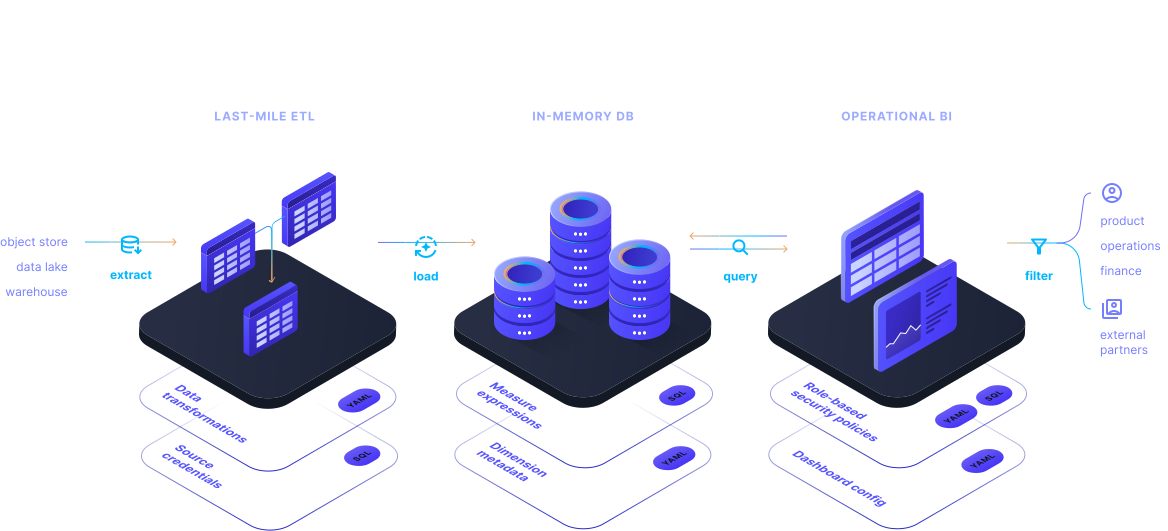
Rill automatically turns your SQL data models into interactive, exploratory dashboards. It ingests data from your external sources into an embedded, high-performance OLAP engine. By defining metrics and dimensions upfront, Rill aggregates and optimizes the data, creating a responsive interface that allows users to slice and dice billions of records instantly without waiting for query processing.
This approach means engineering teams can:
- Orchestrate data out of cloud data warehouses or object stores into the fast serving layer.
- Define metrics & dimensions in metrics view to automatically aggregate and prune raw tables.
- Deploy your project to Rill Cloud without managing separate BI servers or database infrastructure.
Built for Operational Analytics
Operational intelligence provides decision-making capabilities that are complementary to traditional Business Intelligence (BI).
- Business Intelligence drives complex decisions that occur daily or weekly, often on historical data (e.g., "How did we perform last quarter?").
- Operational Intelligence fuels fast, frequent decisions on real-time and near-time data by hands-on operators (e.g., "Why is site latency spiking right now?" or "Which campaign is driving traffic this hour?").
Rill is built for this "fast" mode. It empowers product managers, operations teams, and engineers to explore data at the speed of thought, identifying trends and anomalies as they happen, without waiting for pre-computed reports.
AI-Native Analytics
Rill's code-first architecture — YAML and SQL files that define your entire analytics stack — makes it uniquely suited for AI-powered workflows.
Build with AI agents
Because Rill projects are just files, AI coding agents like Claude Code and Cursor can build and iterate on your entire project: connect data sources, write transformation models, define metrics views, and create dashboards. Run rill init to generate agent instructions and an MCP connection out of the box. See the Agentic Quickstart to get started.
Chat with your data
AI Chat is built into Rill Cloud, letting you ask questions about your data in natural language. Responses are grounded in your predefined measures and dimensions, so answers are accurate and governed — not hallucinated from raw tables. Every response includes links back to your Explore dashboards so you can verify the numbers.
Connect external AI tools
The Rill MCP Server connects your projects to Claude Desktop, ChatGPT, and other MCP-compatible AI assistants. Your team gets the same governed analytics in whatever AI tool they prefer, with security and access controls enforced by Rill.
Improve AI with instructions
Add ai_instructions to your project and metrics view YAML files to give AI agents context about your business logic, terminology, and data quirks — improving the quality of responses across all AI surfaces.
Key Benefits
- Performance: Rill achieves performance that end users love by serving dashboards from in-memory data models, often reducing the data footprint by 10–100x compared to raw events.
- Developer Experience: Define your entire analytics stack—from data models to dashboards—using code. This brings the benefits of version control, collaboration, and automation that software development teams rely on.
- Cost Effective: Build analytics directly on your storage. Rill lowers costs because data can be transformed in place without duplication in a heavy enterprise warehouse.
- AI-Native: Build projects with AI coding agents, chat with your data in natural language, and connect external AI tools — all governed by your predefined metrics.